
ALMOST HUMAN // DAFT PUNK GEAR & INTERACTIVE HARDWARE SERIES
THE MACHINES: DAFT PUNK GEAR & DRUM MACHINES
If you want to understand Daft Punk gear, forget pristine million-pound recording consoles in white coats. In 1996, the entire control deck of French Touch sat on one overcrowded table in a Montmartre bedroom: a pile of second-hand Daft Punk drum machines, grumpy 12-bit samplers, squelching analogue bass boxes, a redlined Mackie mixer, and a 100MB Iomega Zip drive praying it wouldn’t click itself to death.
We’re rebuilding the ten most iconic machines from their studio arsenal as free, browser-based Web Audio instruments—and breaking down every single box from their original 1997 Homework equipment list below.
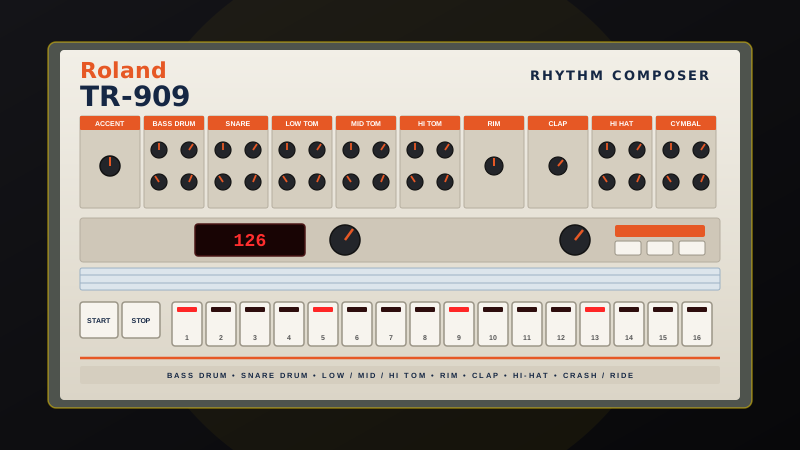
PLAYABLE NOW IN YOUR BROWSER // ZERO PLUGINS NEEDED
INTERACTIVE DAFT PUNK DRUM MACHINES
Before you spend four grand on eBay for a forty-year-old box from Japan that smells faintly of 1980s capacitor fluid, take our custom Web Audio simulators for a spin. Built with genuine circuit behaviour, 16-step sequencers, and switchable Mackie / Alesis 3630 signal chains.
● SERIES #01 • 1983 • LIVE SIMULATOR
ROLAND TR-909
Tadao Kikumoto’s 1983 analogue-digital hybrid masterpiece. Anchored Revolution 909, Da Funk, Burnin’, and virtually the entire Alive 1997 tour. Analogue transistor kick, snare, toms, rim, and clap paired with crunchy 6-bit PCM hi-hats and cymbals.
Simulator Specs: 44.1kHz studio WAV masters, 3-stage step velocity + Total Accent bus, real-time 3.5kHz Attack transient click, and switchable Mackie CR-1604 / Alesis 3630 bus modes.

● SERIES #02 • 1980 • LIVE SIMULATOR
ROLAND TR-808
The 1980 all-analogue happy accident. Built with deliberately noisy transistors that gave it that unmistakable sizzle, a bridged-T sine bass drum that rumbles for nearly two seconds, and the most famous 540Hz + 800Hz cowbell in recorded history.
Simulator Specs: 100% real-time Web Audio analogue circuit synthesis across all 16 voices, 5 authentic dual-voice hardware switches (Tom/Conga, Rim/Clave, Clap/Maracas), and 8 classic presets.
Machines In Our Simulator Series
Boxes In The 1997 Bedroom Rack
Megabytes On An Iomega Zip Disk
The Infamous Alesis Compressor
THE RUE DURANTIN ARCHIVE // EVERY SINGLE BOX
THE COMPLETE 1997 DAFT PUNK GEAR LIST
Verified directly from Thomas Bangalter and Guy-Manuel’s 1997 studio equipment manifest. No mythical custom NASA synthesisers—just twenty-six real-world hardware boxes wired together with questionable amounts of gain. Click through the six categories below.
The Rhythm Section: Roland & Linn
• Roland TR-909: The undisputed boss of Homework. If you hear a kick drum on a 90s Daft Punk record that feels like it’s rearranging your ribcage, it’s the 909.
• Roland TR-808: Deployed for deep sub-bass boom, razor-sharp hand claps, and that glorious dual-square-wave cowbell.
• Roland TR-707: The 1985 8-bit digital cousin to the 909. Crisp PCM rimshots, claps, and hi-hats—plus its DIN-Sync and MIDI clock kept the rest of the antique Roland fleet marching in time.
• Linn LinnDrum & Linn 9000: Roger Linn’s legendary EPROM sample drums. Punchy, dry 1980s snares, cabasas, and toms that gave French Touch its unmistakable disco-meets-techno snap.
Mono Acid Boxes & Polysynths
• Roland TB-303: Designed in 1981 to replace a human bass guitarist (it failed hilarious badly at that) and reborn as the screaming, squelching 18dB/octave acid monster at the heart of Da Funk.
• Roland Juno-106: Six voices of warm DCO analogue polyphony with a built-in BBD stereo chorus so lush you could press one chord and call it a record. Also responsible for raw, screaming lead textures on Homework.
• Roland MC-202: Basically an SH-101 monophonic synth glued to a quirky two-channel step sequencer. Rubbery, punchy electro basslines for days.
• Roland MKS-80 (“Super Jupiter”): A massive 8-voice rackmount analogue polysynth packing Jupiter-8 and Jupiter-6 DNA into two heavy rack units.
• Sequential Circuits Prophet-VS: Dave Smith’s 1986 vector synthesiser—four digital wavetable oscillators blended with a joystick through rich analogue Curtis filters. Glassy, sci-fi pads that foreshadowed Discovery.
12-Bit Grit & Micro-Chopping
• E-mu SP-1200: The 12-bit, 26.04 kHz sampling drum computer that turns any polite disco loop into glorious, crunchy concrete. With only 10 seconds of sample memory, it forced you to pitch records up at 45 RPM, sample them, and pitch them back down.
• Ensoniq ASR-10: Their main keyboard/rack sampling workhorse, famous for its warm converters and built-in DP/4-class effects processor.
• Akai S01: A delightfully basic 16-bit mono rack sampler with a grand total of 1 megabyte of RAM. Proof that limitations breed genius.
• E-mu Emulator III (EIII): A colossal tank of a studio sampler with legendary analogue filters and stereo warmth.
• Roland S-760: A 1U rack sampler that plugged into a CRT computer monitor and mouse—allowing surgical waveform chopping long before modern DAWs existed.
The Brains Of The Operation
• Alesis MMT-8: A cheap black plastic 8-track hardware MIDI sequencer that cost peanuts and ran their entire Alive 1997 live show. Producer trivia: the MMT-8 was notorious for randomly wiping its own memory if static electricity looked at it funny, so every 90s techno act owned three of them and backed them up to cassette tape like their lives depended on it.
• Apple Macintosh + Emagic MicroLogic: Before Apple bought Emagic and turned it into Logic Pro, a beige Mac running MicroLogic handled their studio MIDI arrangement alongside the hardware step sequencers.
Pumping Compressors & 4-Pole Filters
• Alesis 3630 Compressor: The budget dual-channel VCA/RMS compressor that became the most famous box in French house. Patching the 909 kick into the 3630’s sidechain key input made the whole track duck and breathe on every beat.
• Waldorf MiniWorks 4-Pole: A tiny desktop MIDI-controllable analogue low-pass filter module. Whenever you hear a massive, liquid filter sweep opening up across an entire Daft Punk loop, there’s a high chance it’s this little blue box.
• Ensoniq DP/4+: A four-channel parallel multi-effects monster responsible for iconic phasers, flangers, vocoding, and crunchy distortion.
• Lexicon Vortex & Lexicon JamMan: Morphing psychedelic modulation/delay effects and early hardware live-looping.
• Alesis Microverb III, Yamaha Digital Delay, Behringer Compressor & Parametric EQ, LA Audio Gate/Compressor: Proof that you don’t need boutique price tags when you know how to twist a knob.
Redlining Into Tape (& The Mighty Zip Disk)
• Mackie CR-1604 & Mackie MS-1202: The two compact analog mixers that glued the whole bedroom together. Driving the channel trim pots into the red gave their drums that unmistakable crunchy, harmonically saturated punch.
• Panasonic SV-3700 Pro DAT Recorder: No 96-track Undo button here. They performed live mute-and-filter passes on the Mackie desk and recorded the stereo master straight onto Digital Audio Tape.
• Iomega Zip Drive: Listed proudly at the bottom of their 1997 gear sheet under “OTHER.” A chunky 100-megabyte floppy-on-steroids that held their precious sampler banks. If you produced music in 1997, the sound of an Iomega Zip disk going click… click… click was scarier than any horror film ever made.
Next up in our simulator lab: the silver box behind Da Funk—the 1981 Roland TB-303 Bass Line.
Why Real Hardware Still Feels Different
Plugins are brilliant (and they don’t weigh thirty kilos or randomly blow a fuse five minutes before doors open), but there’s a reason we obsess over real hardware boxes at Almost Human.
When you grab a physical cutoff knob on a mono synth or punch mute buttons on a drum machine & groovebox in real time, you commit to the moment. That’s why our live tribute show ditches DJ decks and pre-baked stems entirely in favour of real grooveboxes, drum machines, and mono & polysynths.
IN THE WORKBENCH // SERIES #03 – #10
UPCOMING HARDWARE SIMULATORS
We’re coding our way through the rest of the robots’ studio rack. Here are the next eight interactive Web Audio machines currently on the bench.
#03 • COMING NEXT
Roland TB-303
1981 Acid Bass Line • Resonant diode-ladder filter, accent & slide sequencer behind Da Funk.
#04 • IN DEVELOPMENT
Roland Juno-106
1984 Polyphonic DCO Synth • Iconic BBD Chorus I/II and raw screaming leads from Homework.
#05 • IN DEVELOPMENT
LinnDrum / Linn 9000
1982–84 Digital EPROM Drums • Walnut cheeks, mixer faders, and punchy Discovery-era drums.
#06 • IN DEVELOPMENT
Roland TR-707
1985 Digital PCM Rhythm Composer • Crisp 8-bit house snares, rimshots, claps & matrix LCD.
#07 • IN DEVELOPMENT
Roland MC-202
1983 MicroComposer • SH-101 analogue VCO/VCF voice with dual-channel step sequencing.
#08 • IN DEVELOPMENT
Oberheim DMX
1981 EPROM Digital Drums • Walnut trim and huge, booming early-80s electro & boogie punch.
#09 • IN DEVELOPMENT
Sequential Drumtraks
1984 Pitchable EPROM Drums • Tunable gritty percussion and classic French Touch swing.
#10 • IN DEVELOPMENT
Sequential Prophet VS
1986 Vector Synthesiser • 4-oscillator joystick morphing and shimmering Discovery chords.
HOW THE ROBOTS WIRED THEIR RACK
THE FRENCH TOUCH SIGNAL CHAIN
Mackie CR-1604 preamps pushed into the red + an Alesis 3630 sidechain = instant 1997 Paris.
Why Cheap Boxes Beat Expensive Studios
If you plug a Roland TR-909 straight into a clean modern audio interface, it sounds polite. Thomas and Guy-Man didn’t want polite. They ran their drum machines and E-mu SP-1200 loops through three gloriously aggressive stages:
1. Mackie CR-1604 Preamp Clipping: By cranking the input trim on their Mackie mixer until the red overload LEDs stayed permanently lit, they shaved off harsh digital transients and added thick analogue harmonic saturation.
2. Waldorf 4-Pole & Ensoniq DP/4+ Filtering: Loops were swept live by hand through resonant low-pass filters and phasers before hitting the master bus.
3. The Alesis 3630 Ducking Pump: A split feed of the 909 kick triggered the sidechain input of the Alesis 3630, slamming the entire stereo bus down by 8dB on every quarter-note beat before sucking the room back up into the speakers.
SYNTH NERD Q&A // STRAIGHT FROM THE RACK
DAFT PUNK GEAR & DRUM MACHINES FAQ
What drum machines did Daft Punk use on Homework?
Their 1997 Homework equipment list included four core drum machines: the Roland TR-909, Roland TR-808, Roland TR-707, and Linn LinnDrum / Linn 9000, alongside an E-mu SP-1200 sampling drum machine.
What synthesizer made the acid bassline on Da Funk?
The main distorted, squelching lead riff on Da Funk was programmed on a vintage Roland TB-303 Bass Line synthesizer, layered with a massive boogie sub-bass line from a Roland Juno-106 / MC-202 and compressed heavily through an Alesis 3630.
Can I play Daft Punk's drum machines online in my browser?
Yes! Our Roland TR-909 and Roland TR-808 interactive Web Audio simulators run directly in your desktop or mobile browser with zero downloads or plugins required—complete with French Touch presets, real-time knob tweaking, and Mackie / 3630 saturation modes.
What sequencer ran Daft Punk's 1997 live shows?
During the Alive 1997 tour, their hardware rack was driven by chained Alesis MMT-8 8-track MIDI sequencers syncing their Roland drum machines, TB-303s, and samplers in real time.
What hardware does Almost Human use for live shows?
Unlike typical tribute DJ sets, Almost Human doesn’t use DJ decks or pre-recorded stems. We perform live in custom Gold and Chrome LED helmets using a dedicated hardware rig of grooveboxes, drum machines, and mono & polysynths. Check out our Live Tribute Shows for full details.
EXPERIENCE THE HARDWARE LIVE
SEE ALMOST HUMAN ON TOUR
No DJ decks or pre-recorded stems—synchronised Gold & Chrome LED helmets and a live hardware rig of grooveboxes, drum machines, and mono & polysynths recreating the raw energy of Daft Punk live. Available for festivals, corporate events, and live venues across the UK and internationally.