
ABOUT DAFT PUNK // PARIS 1993 – 2021 // DON’T PANIC, IT’S JUST HOUSE MUSIC
ABOUT DAFT PUNK
The best thing about Daft Punk is how utterly improbable the whole story is. Somewhere in the vast, mostly harmless expanse of 1990s pop culture, two wonderfully stubborn Parisian teenagers took a terrible gig review, bought a pile of battered second-hand drum machines, wired them through a cheap mixer until the lights flickered, and accidentally rewrote the entire rulebook of electronic dance music.
Then they put on shiny sci-fi helmets, refused to explain themselves, built a giant glowing pyramid, won six Grammys, and blew themselves up in a desert. Honestly? Fair play.
CHAPTER 01 // THE BEST BAD REVIEW IN HISTORY
“A DAFT PUNKY THRASH”
Before the helmets, before the Grammys, and long before anyone had to figure out how to fit a glowing pyramid through a festival loading bay, Thomas Bangalter and Guy-Manuel de Homem-Christo met at school in Paris in 1987. They were twelve, bonded over 1960s rock, sci-fi films, and the sheer joy of making loud noises.
In 1992 they formed a scrappy indie-rock trio called Darlin’ (alongside Laurent Brancowitz, who later went on to form Phoenix—Parisian schoolyards in the early 90s clearly had something interesting in the tap water). They sent a demo to the UK music paper Melody Maker, and reviewer Dave Jennings promptly binned them as “a daft punky thrash.”
Most bands would sulk for a fortnight. Thomas and Guy-Man laughed, binned the guitars, bought a drum machine and a synthesiser, nicked the insult as their new name, and went straight to a rave at EuroDisney in 1993. There they handed a demo cassette to Stuart Macmillan of Glasgow’s legendary Soma Quality Recordings. A few months later, The New Wave dropped, followed by Da Funk—and suddenly house music had two new captains at the helm.
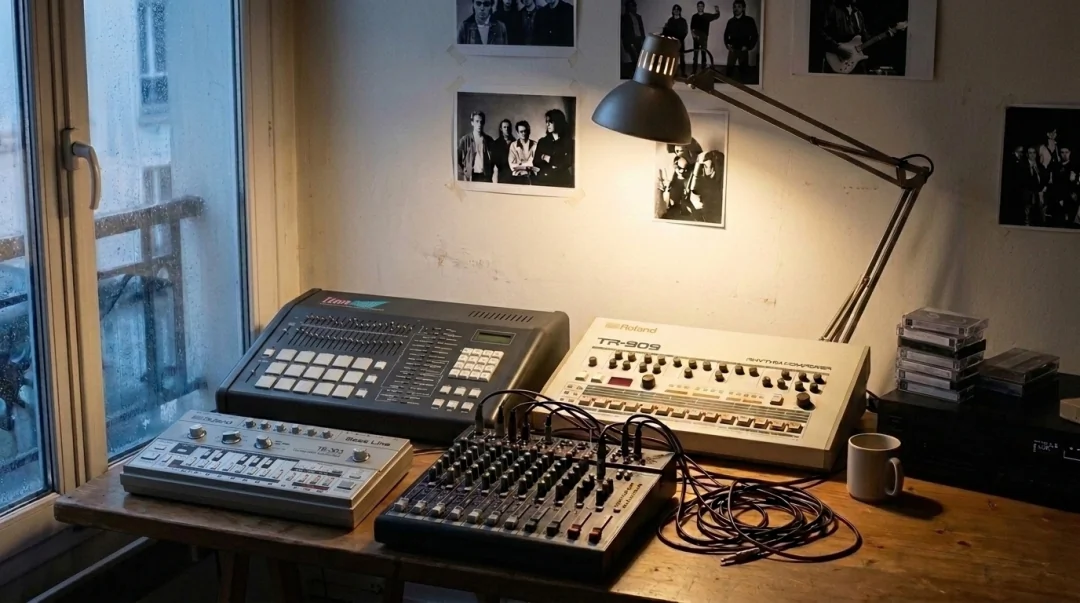
Rue Durantin, Montmartre: Linn 9000, TB-303, TR-909, a redlined mixer, and a stack of DAT tapes.
Years In Orbit (1993–2021)
Studio Albums (Zero Filler)
Grammy Awards Won
The Magic Time (9:09 AM)
CHAPTER 02 // FIVE ERAS, ZERO BORING BITS
THE FOUR ALBUMS (& THAT PYRAMID)
Most bands release twelve albums and hope you forget four of them. Daft Punk released four proper studio albums in twenty-eight years—and every single one sounded like it had been beamed in from a completely different star system. Click through the eras below.
Homework (1997) — The Bedroom Riot
Recorded almost entirely in Thomas Bangalter’s bedroom on Rue Durantin in Paris, Homework is raw, loud, unapologetically crunchy, and still hits harder on a proper club rig than half the tracks released this Friday.
They recorded live hardware jams straight onto DAT tape with no safety net. Da Funk turned a squelching Roland TB-303 bassline into a global pop hit, Around the World proved you only need three words if the bassline is illegal levels of funky, and Revolution 909 stuck two fingers up at the French government’s anti-rave crackdown using the sheer physical force of a Roland TR-909 kick drum.
DJ Verdict: If you drop Rollin’ & Scratchin’ or Burnin’ at 2 AM in a dark room, people still lose their minds.
Discovery (2001) — Disco In Outer Space
After making the grittiest house album of the 90s, everyone expected Homework Part 2. Instead, Daft Punk turned up in full robot helmets with a glittering, joyful love letter to 1970s disco, childhood Saturday-morning anime, and impossible sample-chopping wizardry.
One More Time (voiced by the late, great Romanthony), Digital Love, Aerodynamic, Harder, Better, Faster, Stronger—it’s practically a Greatest Hits album disguised as a second LP. And because merely making a classic album wasn’t geeky enough, they teamed up with legendary Japanese animator Leiji Matsumoto to turn the entire record into a wordless sci-fi anime film, Interstella 5555.
Producer Verdict: Face to Face alone contains over twenty micro-chopped samples stitched together like a Swiss watch. It’s still witchcraft.
Human After All (2005) — Six Weeks of Stubbornness
Critics were baffled when Human After All arrived. Recorded in just six weeks using two guitars, two drum machines, a vocoder, and an 8-track mindset, it was stark, repetitive, industrial, and deliberately rough around the edges.
What nobody realised in 2005 was that Thomas and Guy-Man had basically built a box of high-voltage LEGO bricks specifically designed to be smashed together live on stage. The moment Robot Rock, Technologic, and Television Rules the Nation collided with Homework and Discovery inside the pyramid a year later, everybody suddenly went: “Oh. Right. Genius.”
Alive 2007 — The Night Festival Production Changed Forever
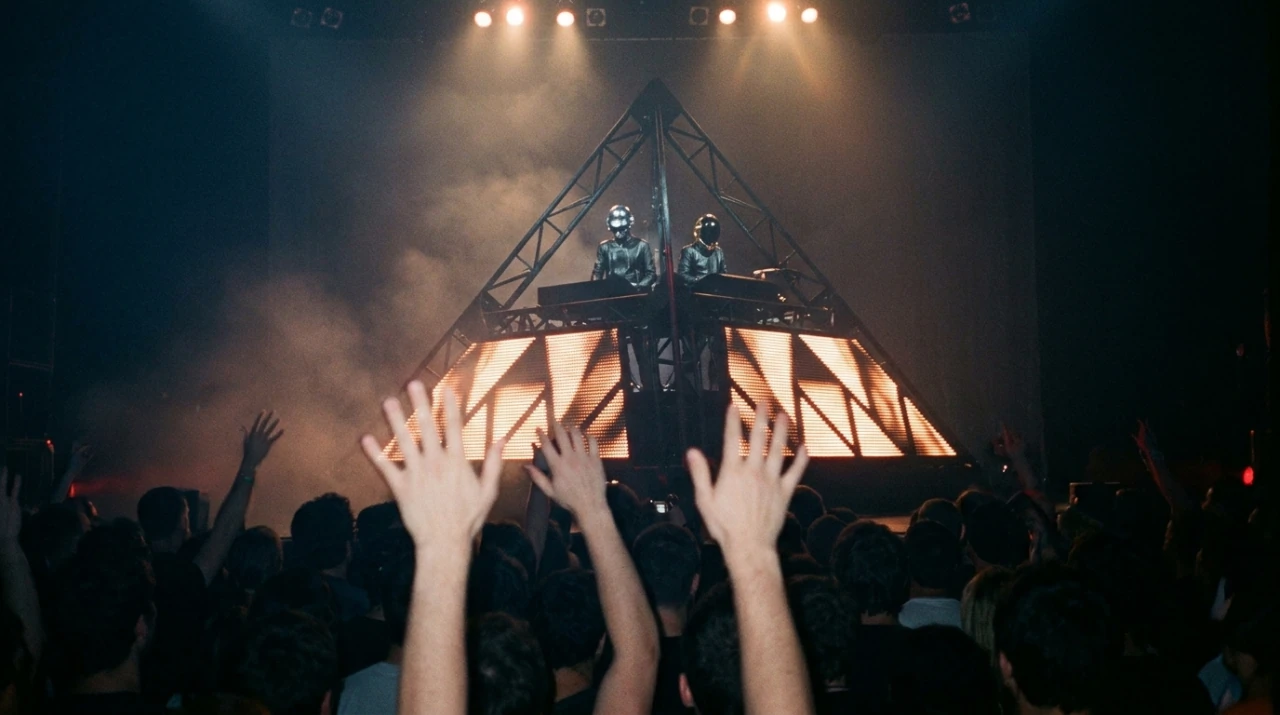
It started at Coachella in April 2006. Word spread across the desert that two robots were inside a colossal, LED-wrapped pyramid remixing their entire back catalogue live on the fly using custom Ableton Live rigs, four Minimoog Voyagers, and futuristic touchscreen JazzMutant Lemur controllers.
Before Alive 2007, electronic acts mostly stood behind a table with a couple of decks and a strobe light. After Alive 2007, every major dance act on Earth suddenly needed a spaceship. The live album recorded at Bercy Arena in Paris isn’t just a live record—it’s arguably the single greatest DJ/live mashup set ever committed to tape.
Random Access Memories (2013) — Robots Playing Human
Just as the entire EDM world was racing to see who could make the loudest laptop drop, Daft Punk went completely the other way. They flew to Los Angeles, booked classic 1970s analogue studios, and invited real musical legends—Nile Rodgers, Giorgio Moroder, Pharrell Williams, Paul Williams, and Julian Casablancas—to play live onto magnetic tape.
Get Lucky took over the planet, the album swept five Grammys (including Album of the Year), and then, on 22 February 2021, they uploaded an eight-minute video called Epilogue, blew up one of the robots in the desert, and quietly signed off. No farewell cash-grab tour. No awkward comeback. Just an immaculate full stop.

Oh, And They Scored TRON: Legacy Too
Because why wouldn’t two massive sci-fi geeks casually drop one of the greatest modern film scores in between studio albums? In 2010 they blended an 85-piece London orchestra at AIR Lyndhurst with giant vintage modular synths for Disney’s TRON: Legacy—and even snuck in a cameo as DJs inside the Grid’s End of Line Club. Peak nerd bliss.
Two helmets, zero ego: the smartest piece of visual storytelling in modern dance music.
CHAPTER 03 // 9 SEPTEMBER 1999 AT 9:09 AM
WHY THEY BECAME ROBOTS
If you ask anyone about Daft Punk’s official lore, they were working in their studio on 9 September 1999 at precisely 9:09 AM (because of course it was 9:09) when their sampler exploded, knocking them out. When they woke up, they had been reconstructed as androids. Pure Douglas Adams logic: if you’re going to invent a backstory, commit to it completely.
The real truth about Daft Punk’s transformation was even smarter. Thomas and Guy-Man hated celebrity culture. They wanted to be able to pop down to the shops in Paris for a baguette without paparazzi hiding in the bushes, and they wanted the music—not their haircuts—to be the star. So they commissioned Hollywood FX wizards Tony Gardner & Alterian Inc. (plus Paul Hahn and Cédric Hervet) to build two bespoke helmets: sleek silver/chrome with a wide visor for Thomas, and smooth golden curved glass for Guy-Man, packed with programmable LED matrices.
By hiding their faces, they accidentally became the most recognisable silhouettes on Earth. Anyone can project themselves into a robot.
CHAPTER 04 // THE PRODUCER’S CORNER (NO GATEKEEPING)
HOW THEY ACTUALLY GOT THAT SOUND
Here’s the best bit for fellow DJs, synth nerds, and bedroom producers: Daft Punk’s early sound wasn’t built on unicorn studio gear. It was built on relatively affordable boxes pushed way past what the instruction manual recommended.
The Roland Drum Machines
The Roland TR-909 was the absolute heartbeat of Homework—punchy analogue kick, sizzling 6-bit hi-hats, instant dancefloor authority. Alongside it sat the booming Roland TR-808 and crisp TR-707. You can actually play our interactive 909 and 808 right here on the site.
Mackie Redline + Alesis 3630
Audio engineers at the time laughed at the budget Alesis 3630 compressor. Daft Punk plugged their 909 kick into its sidechain input, cranked their Mackie CR1604 preamps straight into the red, and invented that huge, breathing, ducking French Touch pump that every dance producer on Earth still copies today.
Samplers, Synths & Talkboxes
From the gritty 12-bit crunch of an E-mu SP-1200 and Ensoniq ASR-10, to a screaming Roland TB-303 and Juno-106, to singing through a DigiTech Talker vocal pedal on Harder, Better, Faster, Stronger—every sound was tweaked by hand until it had proper soul.
QUICK-FIRE ANSWERS // NO FLUFF
FAQS ABOUT DAFT PUNK
Who are the two guys behind Daft Punk?
Daft Punk were French musicians and producers Thomas Bangalter (the taller one in the silver/chrome helmet) and Guy-Manuel de Homem-Christo (the shorter one in the gold helmet). They met at Lycée Carnot secondary school in Paris in 1987 and formed Daft Punk in 1993.
Why did Daft Punk split up in 2021?
On 22 February 2021 they released an eight-minute film titled Epilogue (adapted from their 2006 sci-fi film Electroma), announcing the end of the project after 28 years. Thomas later explained that he felt the story of the robots had reached its natural conclusion—and honestly, going out at the absolute top rather than fading out is about as Daft Punk as it gets.
Are Daft Punk ever going to tour again?
Every few months a rumour pops up on the internet claiming they’re headlining Glastonbury or the Olympics, and every time it turns out to be wishful thinking. Both Thomas and Guy-Man have moved onto solo film scores, orchestral works, and production projects. That’s a big part of why we built Almost Human—so fans in the UK and beyond can still experience that raw live hardware energy on a proper sound system.
What drum machines and synths did Daft Punk use?
Their classic hardware rack included the Roland TR-909, Roland TR-808, Roland TB-303, Roland Juno-106, Roland MC-202, Linn 9000, Oberheim DMX, Sequential Prophet VS, Mackie CR1604 mixer, and Alesis 3630 compressor. You can test-drive our interactive simulators over on The Machines page.
Did they really record Homework in a bedroom?
Yep—almost all of it was tracked in Thomas Bangalter’s bedroom in Montmartre, Paris, directly to DAT tape. No giant SSL console, no army of engineers—just loud hardware, clever filtering, and a lot of redlining.
How can I experience Daft Punk live in the UK?
Right here! Almost Human is the UK’s premier authentic Daft Punk tribute live act, performing in custom handcrafted Gold and Chrome LED helmets. Unlike standard DJ sets, we don’t use decks or pre-recorded stems—we perform live on hardware grooveboxes, drum machines, and mono & polysynths. Check out our Live Tribute Shows or get in touch to book.
THE ROBOTS RETIRED // THE PARTY DIDN’T
EXPERIENCE ALMOST HUMAN LIVE
No DJ decks, no pre-recorded stems—just handcrafted Gold & Chrome LED helmets and a live hardware rig of grooveboxes, drum machines, and mono & polysynths played by genuine Daft Punk obsessives. Available for festivals, clubs, weddings, and corporate events across the UK and beyond.